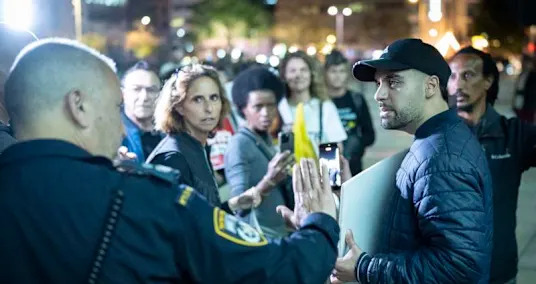
Protests took place in Tel Aviv, Jerusalem, Haifa, and Beersheba, as a survey found broad but uneven support among Jewish Israelis for Operation Roaring Lion.
Israel Police arrested 21 anti-war protesters Saturday night as demonstrations against the conflict with Iran expanded in multiple cities despite restrictions on public gatherings.
Protests took place in Tel Aviv, Jerusalem, Haifa, and Beersheba, with hundreds of participants reported in Tel Aviv and Jerusalem and about 100 in Haifa, marking the largest turnout since weekly demonstrations began. Authorities said 13 people were arrested in Tel Aviv and eight in Haifa.
Police said the gatherings were not approved under Home Front Command regulations that ban events with more than 50 people. Officials said the increase in turnout followed calls by groups opposing the government to protest despite the restrictions.
“During a situation assessment that took place at the scene with a Home Front Command representative… it was clarified that there was a real risk to human life and accordingly, Yarkon [precinct] police commander Tzachi Sharabi ordered the gathering to be dispersed,” police said.
Hadash-Ta’al chairman Ayman Odeh, an Arab lawmaker involved in the protests, criticized the police response, calling officers fascists “in the service of the government” and saying they were afraid of “the heroic citizens who went out, despite everything, to make their voice heard.”

Survey shows broad, uneven support for war
The demonstrations come as a March 2026 survey by the Israel Democracy Institute found broad but uneven support among Jewish Israelis for Operation Roaring Lion. Support was strongest on the Right at 87% and about half on the Left.
The survey also found that Jewish and Arab respondents largely agreed that Iran’s resilience has been stronger than expected. Most Jewish respondents said Israeli society could sustain the campaign for up to one month, while 28% said as long as needed. Arab respondents were less optimistic about how long the public could endure the conflict.
A majority of Jewish respondents said Prime Minister Benjamin Netanyahu’s decision was driven by security considerations, while most Arab respondents viewed it as political.
LATEST POSTS
- 1
 With Obamacare premium hikes, more people opting for no coverage or cheaper plans
 - 2Mexico says a third of 130,000 missing people might be alive, fueling criticisms by families
- 3NASA Artemis II tracker: Crew less than 60,000 miles from moon ahead of Monday flyby
- 4Saturn shines with the waxing moon at sunset on Nov. 29
- 5Most loved Occasion Dish: What Makes Your Merry Table?




- Revvity says it will exceed 2025 profit forecast range
- Trial of pro-Palestine activist begins
- An Extended time of Careful Nurturing: Individual Bits of knowledge on Bringing up Kids
- New ‘Cloud-9’ object could reveal the secrets of dark matter
- Kuwait is softening stance on Israel, dissident tells ‘Post’ after viral UN speech
- How to watch 'A Charlie Brown Christmas' for less with this Apple TV Black Friday deal
- Minute Maid’s frozen juice concentrate is ending after 80 years — and so is a certain kind of kitchen ritual
- Moon memorial: Artemis 2 astronauts name lunar 'bright spot' after mission commander's late wife
- Mom finds out she has cancer after noticing something was off while breastfeeding