When you buy through links on our articles, Future and its syndication partners may earn a commission.

The parallels between the Artemis 2 and Apollo 8 moon missions now include a stirring holiday message.
As they circled the moon on Dec. 24, 1968, the three Apollo 8 astronauts read the first 10 verses of the Book of Genesis during a live TV broadcast that reached an estimated 25% of Earth's population.
Mission commander Frank Borman wrapped up the reading with these words: "And from the crew of Apollo 8, we close with good night, good luck, a Merry Christmas, and God bless all of you, all of you on the good Earth."

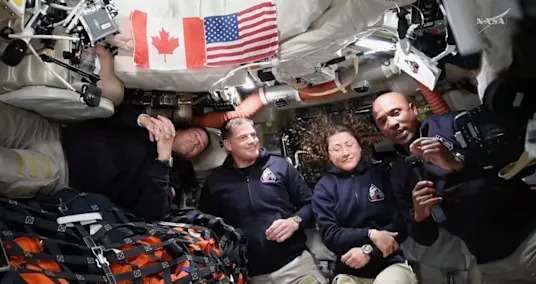
On Saturday (April 4), as Artemis 2's Orion capsule sped toward the moon, a CBS News reporter asked mission pilot Victor Glover if he wished to share any Easter thoughts with those of us here on Earth.
"I don't have anything prepared. I'm glad you brought it up, though; I think these observances are important," Glover responded.
Then he gave us some words that showed how thoughtful and eloquent he is, and how well he can think on his feet.
"You guys are talking to us because we're in a spaceship really far from Earth, but you're on a spaceship called Earth that was created to give us a place to live in the universe," Glover said. "Maybe the distance we are from you makes you think what we're doing is special, but we're the same distance from you. And I'm trying to tell you — just trust me — you are special."
Glover invoked God and the Bible in his impromptu address, but he took pains to reach believers and non-believers alike
"In all of this emptiness — this is a whole bunch of nothing, this thing we call the universe — you have this oasis, this beautiful place that we get to exist together," he said of Earth. "I think, as we go into Easter Sunday, thinking about all the cultures all around the world, whether you celebrate it or not, whether you believe in God or not, this is an opportunity for us to remember where we are, who we are, and that we are the same thing, and that we've gotta get through this together."
Apollo 8 and Artemis 2 are the first missions of their respective programs (Apollo and Artemis) to send people to the moon. (In fact, Apollo 8 was the first human spaceflight mission ever to go beyond Earth orbit.)
Like Apollo 8, Artemis 2 will not land on the lunar surface; rather, it will loop around the moon's far side, a milestone that will occur on Monday evening (April 6). That flyby will slingshot Artemis 2's Orion — which holds Glover, fellow NASA astronauts Reid Wiseman and Christina Koch and Canada's Jeremy Hansen — back to Earth, where it will arrive on Friday (April 10).
On the same day that Apollo 8 delivered its Christmas Eve message, lunar module pilot Bill Anders snapped one of the most iconic photos ever taken — the famous "Earthrise" shot, which showed our gorgeous planet hanging over the moon's desolate gray dirt.
The Artemis 2 astronauts will try to recreate that photo during their lunar flyby on Monday. And hopefully the image will have similar effects to the original, which has been credited with helping to inspire the environmental movement and drawing all of us on this fractured world just a little closer together.
LATEST POSTS
- 1
 Arrow Exploration brings new Colombian oil well on stream ahead of schedule and under budget
 - 219 Peculiar Films You Shouldn't Watch With Your Mum
- 3Governors Ball 2026: Lorde, A$AP Rocky and Stray Kids set to headline
- 42024 Eurovision winner Nemo returns trophy over Israel's participation
- 5Find the Techniques for Powerful Review Propensities: Opening Your Scholarly Potential



- Coca-Cola Co. and bottlers to invest in South Africa operations
- Hot peppers sent him to the ER. Two years later, a ‘ghost bill’ arrived.
- Warship sunk by British fleet, remains of sailor found after 225 years
- Illegal entries into Germany halve over two years, border police say
- Tech Devices 2023: The Most blazing Arrivals of the Year
- 2024 Watch Gathering: The Best Watches of the Year
- ByHeart baby formula from all lots may be contaminated with botulism bacteria, tests show
- The 25 Most Notable Style Crossroads in History
- Artemis II crew take new photo of far side of the moon