When you buy through links on our articles, Future and its syndication partners may earn a commission.

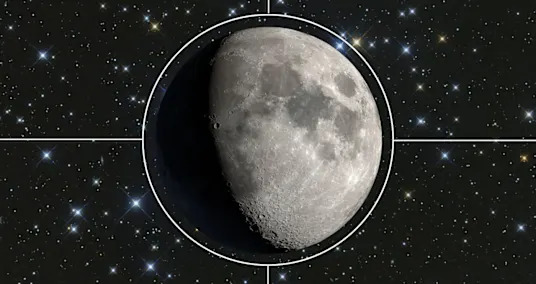
Look to the southern sky as darkness falls on March 27 to see the thickening form of the waxing gibbous moon glowing close to the stars of the Beehive Cluster (M44) at the heart of the constellation Cancer, the crab.
The 77%-lit moon will begin the night less than 2 degrees above the stars of the M44 open cluster, which plays host to roughly 1,000 gravitationally bound stars. The lunar disk will sweep right-to-left across the upper-stars of the Beehive over the course of the night, from the perspective of viewers in the northern hemisphere, at least, making its closest approach at 23:54 EDT (0354 GMT on March 28).
M44 appears as a small, milky patch of light to the naked eye on dark moonless nights. However, the glow of the nearby waxing moon on March 27 may pose a significant challenge to observing the open cluster as it rests close to Asellus Borealis and Asellus Australis, the central stars in the constellation Cancer.
A pair of binoculars can help reveal up to 20 of the cluster's brightest stars, while a 6-inch telescope will bring dozens more stars into view. The cluster formed around 600-700 million years ago, making it relatively young in the context of the 4.6 billion year history of our galaxy, according to NASA.
Turn your telescope on the moon to see the dark expanses of lunar mare scarring its ancient surface, where lakes of liquid lava flooded impact craters before hardening in the space environment. March 27 is also an excellent time to spot the shadowed forms of Copernicus and Tycho — two colossal impact craters surrounded by streaks of bright reflected material

Copernicus can be found close to the line separating night from day on the lunar surface, known as the terminator, while Tycho's 53-mile-wide (85-kilometer) impact basin is located far to the south, featuring a shadowed eastern rim and pronounced central peak.
Want to see the moon up close and witness the ancient light of star clusters shimmer before your eyes? Then be sure to check out our picks of the best telescopes and binoculars for exploring the night sky. While you're at it, why not take a peek at our guide to observing the lunar surface?
Editor's Note: If you captured an image of the moon with M44 and want to share it with Space.com's readers, then please e-mail your photo(s), comments, name and location to [email protected].
LATEST POSTS
- 1
 Met Gala 2026 will celebrate fashion as an 'embodied art form': A guide to the theme, dress code, cochairs and hosting committee of the starry event
- 2Ukraine's naval drones are gunning for Russia's 'shadow fleet.' A security source says a tanker just suffered a critical hit.
- 3Iranian-backed militias escalate in Iraq, targeting Kurdistan Region president Nechirvan Barzani
- 4Figure out How to Use the Experience of a Fender bender Legal counselor for Your Potential benefit
- 5Watch interstellar comet 3I/ATLAS speed away from the sun in free telescope livestream on Nov. 16





- Two reportedly killed as Israel attacks Hezbollah targets in Lebanon
- FDA proposes use of sunscreen ingredient popular in other countries
- Sunken warship found off Danish coast after 225 years in ‘remarkable’ discovery
- Vote in favor of Your Number one Cake Type
- The Green Transformation: 5 Feasible Living Practices
- Transcript: NASA's Jared Isaacman on "Face the Nation with Margaret Brennan," April 5, 2026
- A Manual for Extravagant Vehicles Available in 2024
- Saucony's $125 'Comfy, Stylish' Sneakers Are Now $55
- This professional Santa's dream of spreading holiday cheer fuels stroke recovery