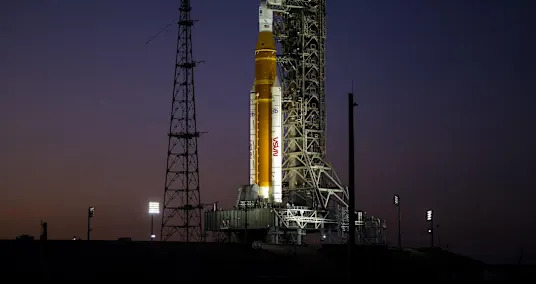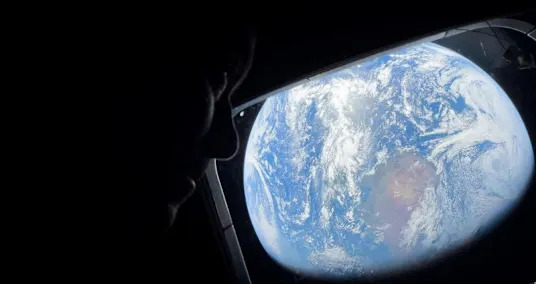
By Joey Roulette
HOUSTON, Texas April 6 (Reuters) - The four astronauts of NASA's Artemis II mission reached the furthest point that any human has been from Earth on Monday, cruising along a path in the Moon's gravitational sphere of influence that will soon take them over the shadowed, lunar far side.
The Artemis II crew, flying in their Orion capsule since launching from Florida last week, awoke around 10:50 a.m. ET for their sixth flight day to a recorded message from late Apollo 8 and 13 astronaut Jim Lovell.
"Welcome to my old neighborhood," said Lovell, who died last year at 97. "It's a historic day, and I know how busy you'll be, but don't forget to enjoy the view... good luck and godspeed."
NASA astronauts Reid Wiseman, Victor Glover and Christina Koch and Canadian astronaut Jeremy Hansen later on Monday were due to reach their maximum distance from Earth of roughly 252,760 miles, some 4,105 miles (6,606 km) beyond the record held by Lovell and his Apollo 13 crew for 56 years.
Next they will sail around the moon's far side, witnessing it from roughly 4,000 miles above its darkened surface as it eclipses what will appear to be a basketball-sized Earth in the distant background.
The milestone is a climactic point in the nearly 10-day Artemis II mission, the first crewed test flight of NASA's Artemis program.
The multibillion-dollar series of missions aims to return astronauts to the moon's surface by 2028 before China, and establish a long-term U.S. presence there over the next decade, building a moon base that would serve as a proving ground for potential future missions to Mars.
The lunar flyby will plunge the crew into darkness and brief communications blackouts as the moon blocks them from NASA's Deep Space Network, a global array of massive radio communications antennas the agency has been using to talk to the crew.
The flyby will last about six hours, during which the astronauts will use professional cameras to take detailed photos of the moon through Orion's window, showing a rare and scientifically valuable vantage point of sunlight filtering around its edges.
The crew will also have the chance to photograph a rare moment in which their home planet, dwarfed by their record-breaking distance in space, will set and rise with the lunar horizon as they swing around, a celestial remix of a moonrise seen from Earth.
A team of dozens of lunar scientists positioned in the Science Evaluation Room at NASA's Johnson Space Center in Houston will be taking notes as the astronauts, who studied an array of lunar phenomena as part of mission training, describe their view in real time.
(Reporting by Joey Roulette; Editing by Don Durfee, Aurora Ellis and Bill Berkrot)
LATEST POSTS
- 1
 Figure out how to Amplify Your Open Record Reward
- 2Flu illness count nears 5 million, with New York City among the hardest hit
- 3Figure out How to Remain Persuaded During Your Internet based Degree Program
- 4Holiday season sees uptick in norovirus cases, according to CDC
- 5Change Your Physical make-up: Compelling Activities for Muscle Building





- Gen Z workplace stereotypes were TV’s favorite punchline in 2025
- 'People We Meet on Vacation' is the 1st of many Emily Henry adaptations: What other books turned movies to look forward to
- I'm 18 and founded an AI startup. I have to wake up at 3 a.m. to work on it before school, but it's worth every sleepless night.
- January full moon wows skywatchers with a striking 'Wolf Supermoon' (photos)
- Step by step instructions to Safeguard Your Teeth During Sports Exercises
- Polish law aimed at lowering petrol prices takes effect on Tuesday
- You finally got a doctor's appointment. Here's how to get the most out of it
- \Step by step instructions to Pick the Best Material Organization for Your Home\
- Artemis II astronauts say they're "ready to go" for moon launch