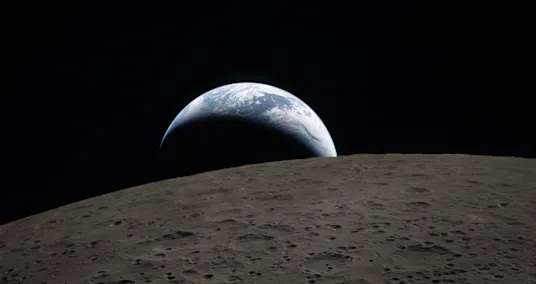
For the first time ever, humans have glimpsed the entire far side of the moon with their own eyes — and their photos are beginning to come in.
In what was the most highly anticipated moment of the Artemis II mission, four astronauts flew around the moon Monday, snapping photos and making detailed observations out the window of their Orion spacecraft.
NASA astronauts Reid Wiseman, Victor Glover and Christina Koch and Canadian astronaut Jeremy Hansen captured a slew of photos of the moon’s rugged terrain, sprawling impact craters and vast, dark plains.

Wiseman, Glover, Koch and Hansen spent around seven hours taking photographs and gathering notes about surface features on the moon during the flyby. They became the first people to see the lunar far side, which is not visible from Earth because that part of the moon permanently faces away from our planet.
Even during the Apollo missions, astronauts couldn’t view much of the moon’s far side because of the paths and timing of their flights.
Now, the four Artemis II astronauts have become trailblazers for all of humanity.
Their early observations elicited celebrations from the mission's lunar science team throughout the flyby. Glover, for instance, was particularly captivated by the jagged topography along the moon’s terminator, the dividing line between its illuminated side and the side cloaked in darkness.
“Boy, I am loving the terminator,” he radioed to Mission Control. “There’s just so much magic in the terminator — the islands of light, the valleys that look like black holes. You’d fall straight to the center of the moon if you stepped in some of those. It’s just so visually captivating.”

Throughout the day, the astronauts spoke about how moving it was to see the moon up close.
“When we have that perspective and we compare it to our home of Earth, it just reminds us how much we have in common,” Koch said. “Everything we need, Earth provides. And that is somewhat of a miracle and one that you can’t truly know until you’ve had the perspective of the other.”

The four crew members spent hours marveling over the moon’s brightness, colors and surface features, radioing vivid descriptions in real time to mission controllers in Houston.
They reported seeing brown and green hues on the near side of the moon and noted the brightness of small, new craters that were most likely created by recent meteorite impacts.
Those observations will be important for lunar and planetary scientists. NASA has said the Artemis II images of craters, ridges and ancient lava flows on the lunar surface could help researchers better understand how the moon — and the solar system — formed.

During the flyby, the Artemis II astronauts set a record for venturing farther from Earth than any other humans. As they swung around the moon, they flew 252,756 miles from our home planet, more than 4,100 miles farther than the Apollo 13 astronauts did in 1970 on their emergency return home.
NASA plans to publicly release the full set of moon photos taken by the Artemis II astronauts, but because of downlink limitations, the bulk will not be retrieved and processed until after the astronauts return to Earth.
Wiseman, Koch, Glover and Hansen will spend the next three days journeying home. They are scheduled to re-enter Earth’s atmosphere and splash down in the Pacific Ocean off San Diego on Friday.
This article was originally published on NBCNews.com
LATEST POSTS
- 1
 See the 'amazing' photos of Earth taken on historic Artemis II moon mission
 - 2Medtronic has 'significant firepower' for multiple acquisitions, executives say
- 3Holden Commodore Turbo BT1 Police Interceptor Offered for Sale in Australia
- 4Kenmore East reacts to their best overall delegation award at WNY Model United Nations General Assembly competition
- 5Instructions to Comprehend and Use Open Record Extra Offers


- King Charles shares cancer treatment update, says it's a 'personal blessing'
- Figure out How to Use the Experience of a Fender bender Legal counselor for Your Potential benefit
- FDA approves Wegovy pill for weight loss: What to know
- Michael Jordan donates $10M to North Carolina medical center in honor of his mother
- Solar storms can trigger auroras on Earth. This star’s explosion could destroy a planet’s atmosphere
- The Starbucks for Life game is back, along with your chance to win a 'Bearista' cold cup. Here's how to get your paws on one.
- Israel explores creation of int'l force with Greece, Cyprus to deter Turkey
- Tesla plans to expand production at German car plant
- Discovery of massive spider's web in Greece reveals unexpected behavior


