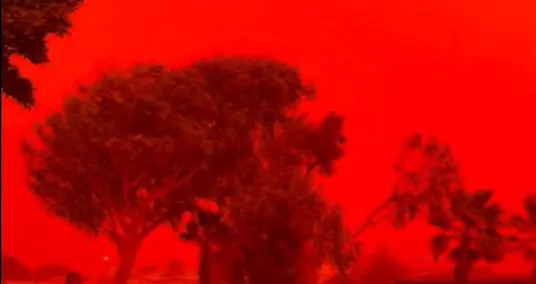
Australia’s skies turned blood red on Friday as Tropical Cyclone Narelle approached the west coast, with residents describing "apocalyptic" scenes and "the sky issuing a final warning”.
The colour change took place as the storm whipped iron-rich soil from northern Western Australia’s distinctive red landscape into the atmosphere, AccuWeather said.
The soil undergoes a weathering process of oxidation over millions of years, according to the US National Oceanic and Atmospheric Administration.
"In this type of environment, these rocks actually begin to rust," the agency explained. "As the rust expands, it weakens the rock and helps break it apart."
That process gives the dirt its reddish hue, with coloured dust scattered by the storm across Shark Bay, Denham and Karratha on the Pilbara coast.
Angus Hines, senior forecaster at the Bureau of Meteorology, told the ABC a thick layer of cloud deepened the effect considerably. Dust storms in the Pilbara and Gascoyne are common but they typically occur under blue skies where direct sunlight softens the colour of particles in the air. On Friday, dense clouds blocked that single light source entirely.
"When you have got the thick cloud cover, the light doesn't feel like it's coming from a single source," he said. "It feels like the light is evenly illuminating the ground, like a panel of lighting as opposed to one bright spotlight."
He described it as "the most striking example of that phenomenon that I've ever seen”.

The Shark Bay Caravan Park in Denham said the dust arrived gradually before engulfing the area entirely. "Incredibly eerie outside and everything is covered in dust," the park wrote on Facebook.
The dust cleared quickly once the cyclone's wind and rain arrived.
The phenomenon, known as mie scattering, occurs when sunlight hits large numbers of microscopic particles matching the wavelength for red light.
Similar scenes have been witnessed before. In 2019, fires along Australia's east coast turned daytime skies black and then blood red. And that same year wildfires in the central Sumatran province of Jambi produced a red sky over Indonesia.
Narelle was a rare triple-strike system. It made landfall first in far north Queensland, then crossed the Northern Territory before reaching Western Australia.
In Exmouth, roofs were torn from buildings and the marina was badly damaged. At least 30 pastoral properties were extensively damaged and a banana grower in Carnarvon said 80 per cent of his crop had been destroyed.
The storm also forced a halt to production at Australia's two biggest liquefied natural gas plants, run by Chevron and Woodside, adding to pressure on global energy supplies already strained by the war in the Middle East.
The cyclone was downgraded to a subtropical system on Saturday, although authorities warned of continued heavy rainfall and strong winds.
Western Australia premier Roger Cook announced one-off payments of up to $2,000 for damaged homes and $4,000 for destroyed ones, as a lengthy clean-up got under way.
LATEST POSTS
- 1
 Google to Use Natural Gas to Power Massive Data Center in Texas
- 2Vote in favor of your Favored sort of footwear
- 3German Court Rejects Bid To Force BMW and Mercedes-Benz To Stop Selling New Combustion-Engine Cars After 2030
- 4‘Trip of suffering’: Gaza evacuee details 24-hour journey to South Africa
- 5Woman, 60, Is Finally Traveling the World Decades After Husband’s Death Held Her Back




- Why More Couples Are Choosing Africa For Their Honeymoon
- 21 Things You Ought to Never Share with Your Childless Companion
- Excursion to Different Universes: the Top Sci-fi Motion pictures Ever
- What you need to know about desalination, a growing source of drinking water
- South Africa pushes for $200B investment
- Elanco's drug gets emergency nod to treat deadly flesh-eating parasite in cats
- Man Charged for Stealing ‘Incredibly Precious’ 286-Year-Old Violin, Worth More Than $200,000, from a Tavern
- Drones, physics and rats: Studies show how the people of Rapa Nui made and moved the giant statues – and what caused the island’s deforestation
- OECD: Iran war dampening global growth